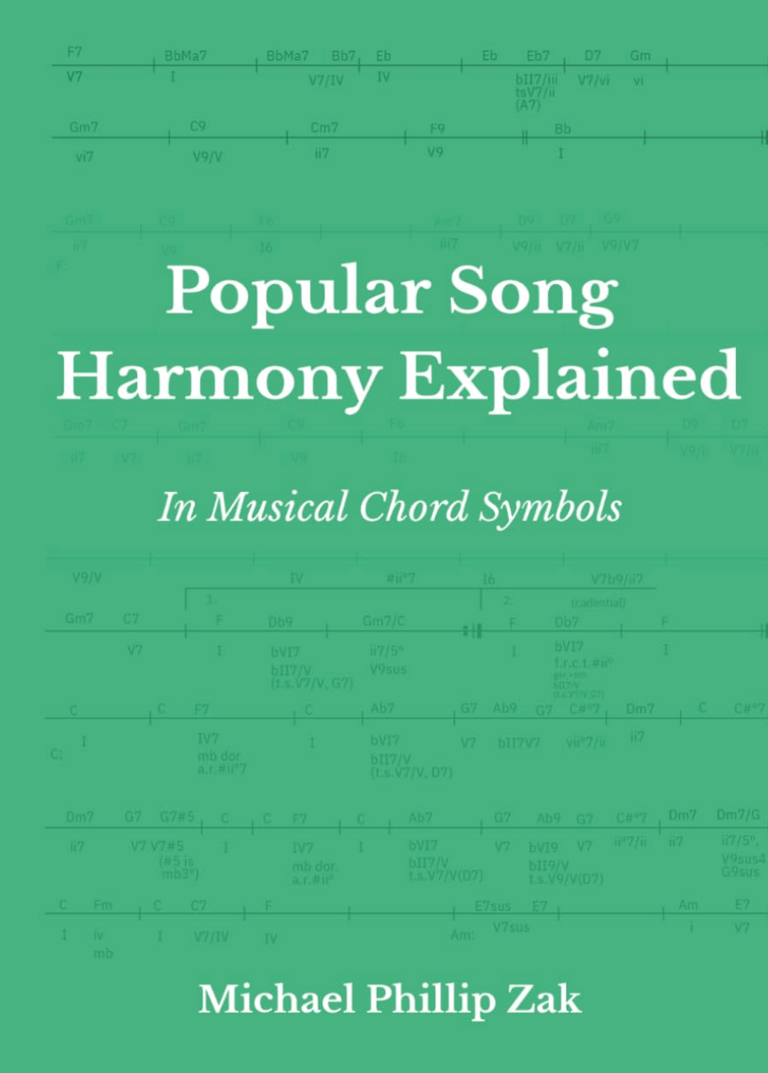
Comprehensive technical guide to musical harmony, chord progressions, and arrangements.
Provides a detailed analyses of harmonic structures, modal borrowing, secondary dominants, and harmonic vectors through many popular songs
Suitable for musicians, composers, arrangers, singers, improvisers, and music enthusiasts
This book presents a systematic framework for understanding functional harmony, chord relationships, and tonal motion through the concept of harmonic vectors. Designed for musicians, composers, arrangers, and advanced students of music theory, this book connects traditional tonal analysis with deeper structural concepts such as harmonic classes, overtone-derived chords, alternate roots, and symmetrical pitch systems.
You’ll learn:
The meaning of tonic, tonality, modality, and diatonic function
How Roman numerals and harmonic classes reveal chord relationships
The mechanics behind ii–V progressions and dominant motion
How secondary dominants expand tonal harmony
The role of diminished seventh structures as leading-tone and common-tone chords
Techniques for root substitutions, alternate roots, and implied harmony
How deceptive resolutions and retrogression affect musical motion
The harmonic logic behind non-diatonic chords and multi-vectored harmony
How the overtone series and acoustic ratios shape tonal systems